Job-Agent User Guide

Your AI co-pilot for a structured and effective job search

Version 2025 - Free Plan
1

What is Job-Agent?

Platform overview

Job-Agent is an AI-powered job search management platform. It analyses your CV, tracks your applications and generates personalised documents for each position.

🧠

Memory Core

Your professional identity automatically extracted from your CV

📊

AI Analysis

Fit score and recommendations for each job posting

📄

Documents

Tailored CV and cover letter generated in one click

🎯

Interview Prep

Company briefing and preparation for key questions

📈

Insights

Analytics dashboard for your job search

Demo accountThis guide uses the test account of Sophie Martin, a marketing manager with 6 years of experience, to illustrate all platform features.
2

Dashboard

Central view of your job search

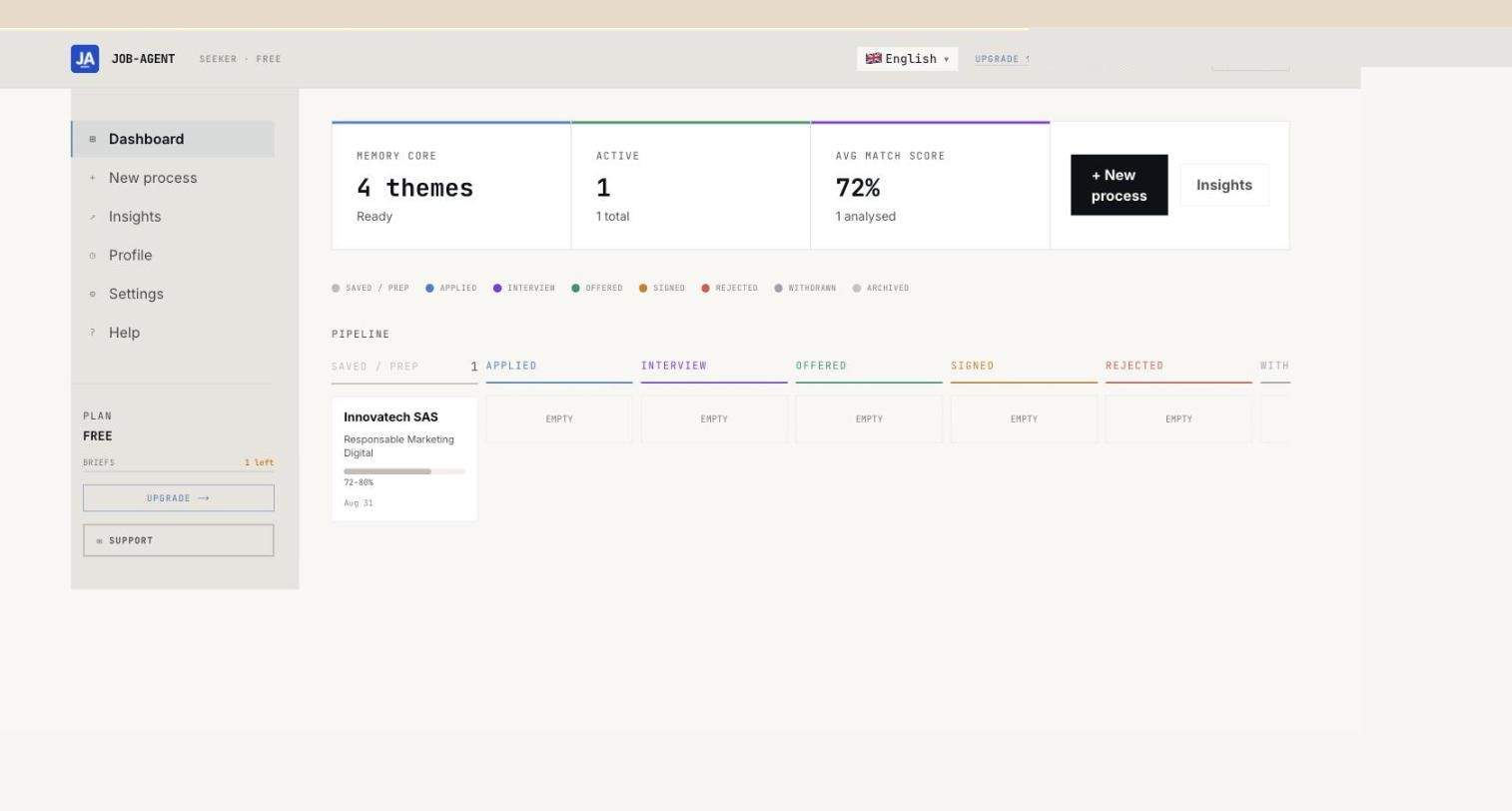
The dashboard is your main entry point after login. It displays your Memory Core, your applications kanban pipeline and key statistics.

Job-Agent dashboard

Memory Core

🧠

Memory Core

4 detected themes, 3 identified roles, 6 years of experience. The heart of your AI profile.

📋

Kanban Pipeline

Visualise your applications by status: Active, Interview, Offer, Rejected.

📊

Average score

72% average fit score across your active applications.

TipClick on a kanban card to go directly to the detail of the corresponding application.
3

A process, tab by tab

Creating it, and the six tabs inside it

Each application is tracked as an independent "process". You enter the job details and the AI handles the analysis.

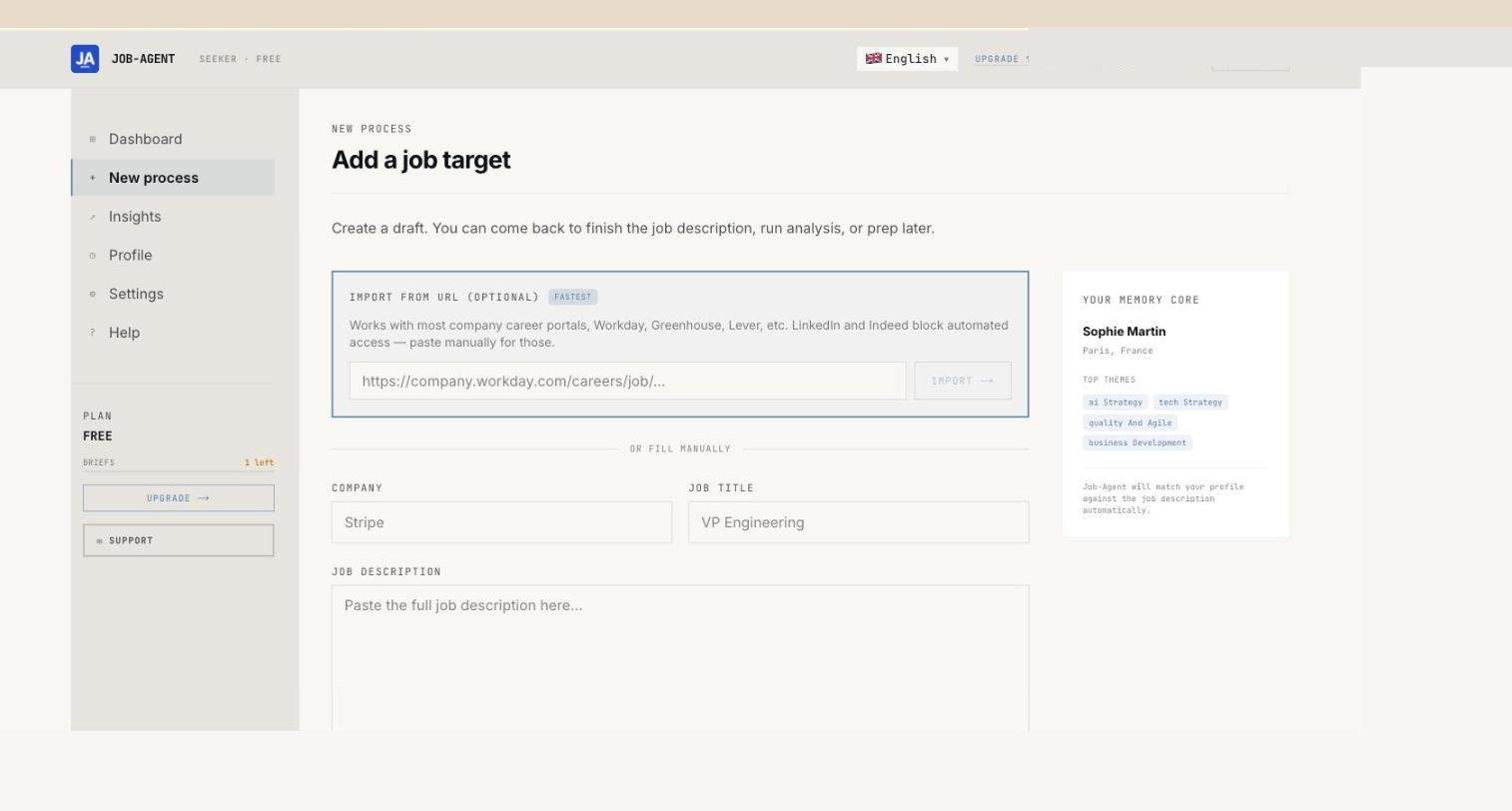
New process form

Click "New Process"

From the dashboard, click the "New Process" button at the top right.

Enter the role and company

Enter the job title (e.g. Digital Marketing Manager) and the company name (e.g. Innovatech SAS).

Paste the job description

Paste the full text of the job posting into the "Job Description" field. The more complete the description, the better the analysis.

Confirm to start the analysis

Click "Create draft & continue". The AI automatically analyses the fit with your Memory Core profile.

Your Memory Core is visible on the rightDuring creation, the right panel displays your detected themes (MARKETING DIGITAL, AI & DATA, etc.) to remind you of the skills that will be assessed.

A process is one application you are tracking. You create it once, then everything for that role lives on a single page, split across six tabs:

3.1

AI Analysis

Fit score and recommendations

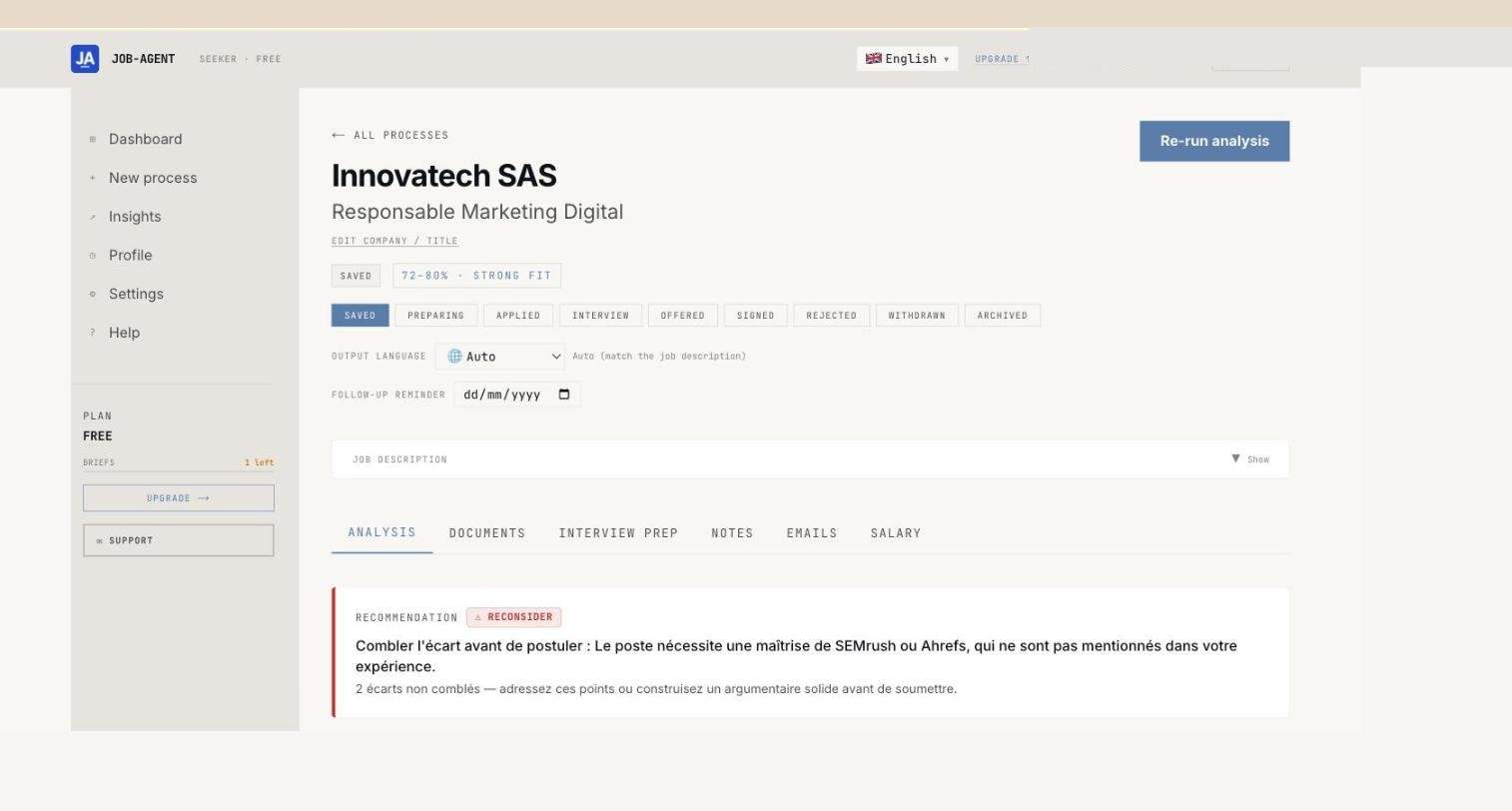
Once the process is created, Job-Agent analyses the fit between your profile and the job posting. The result is a numerical score accompanied by a clear recommendation.

Application fit score
72%
Fit score Innovatech SAS - Digital Marketing
ScoreLevelMeaning
85-100%EXCELLENT FITApplication very strongly recommended
72-84%STRONG FITGood alignment, application recommended
55-71%GOOD FITDecent fit, some gaps
40-54%WEAK FITSignificant gaps to bridge
<40%POOR FITProfile far from the role requirements
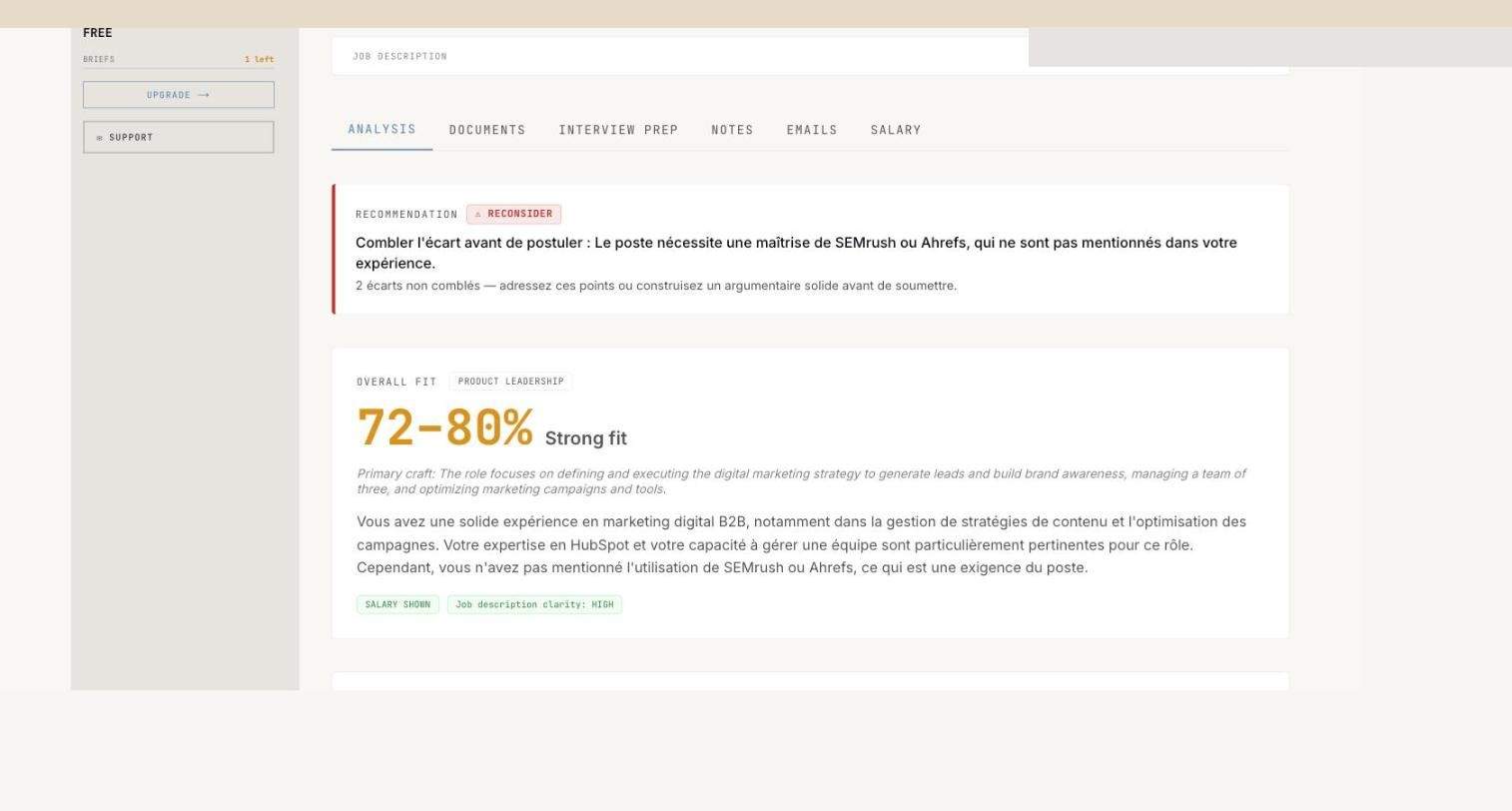
AI analysis detail

Understanding the recommendation

In addition to the score, the AI provides a natural language recommendation that explains:

Detected strengths Identified gaps Specific advice Missing skills
Example for Innovatech SASScore 72-80%, RECONSIDER recommendation. The AI notes strong alignment on digital marketing and data analysis, but identifies a gap on SEMrush/Ahrefs. Advice: highlight equivalent SEO tools already mastered.
3.2

Document generation

Tailored CV and cover letter

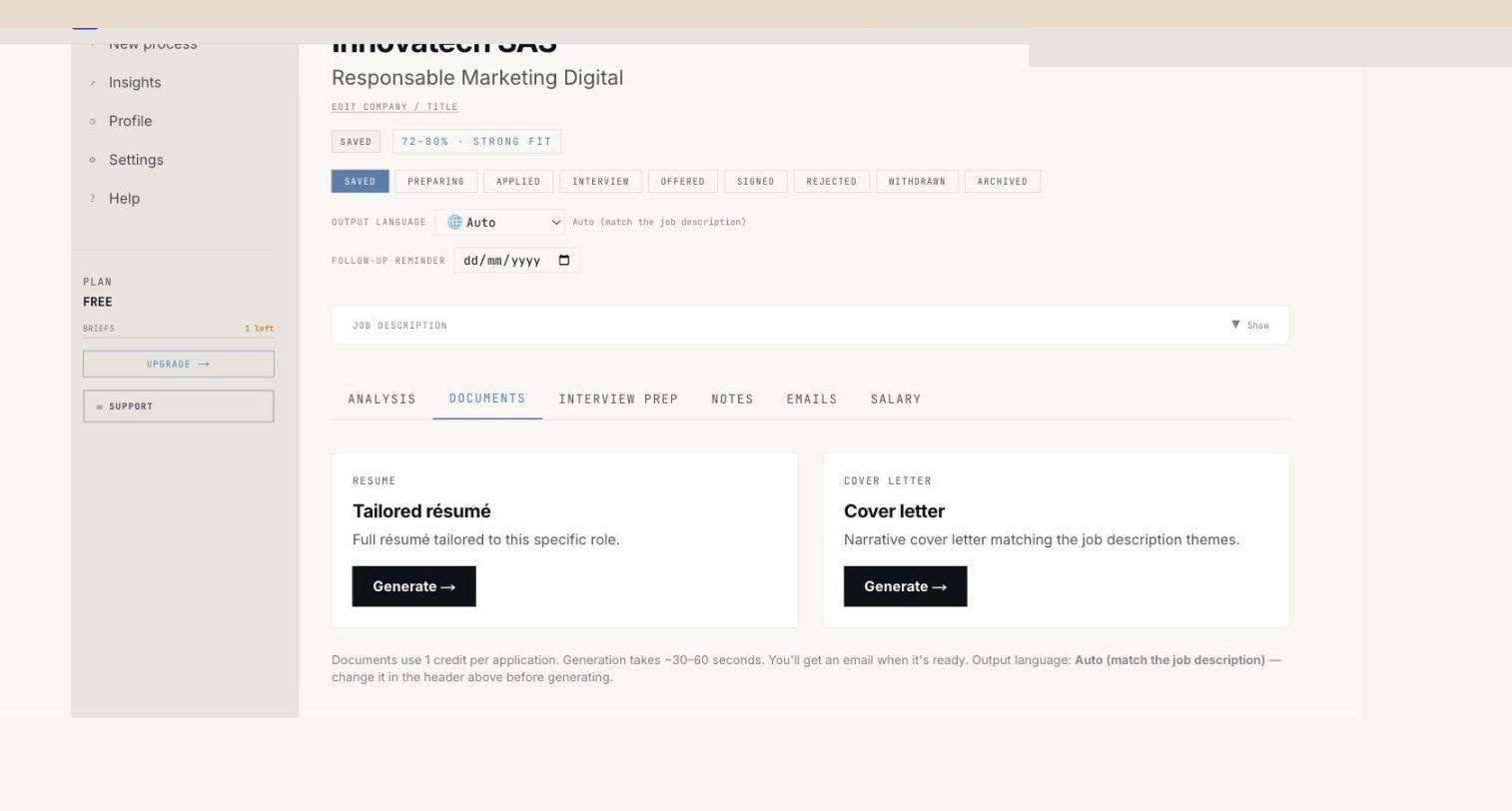
The "Documents" tab lets you generate in one click a CV tailored to the role and a personalised cover letter, based on your Memory Core and the job analysis.

Documents tab
📄

Tailored Resume

CV reordered and optimised to highlight the most relevant skills for this specific role.

✉️

Cover Letter

Cover letter written automatically, tailored to the role and company, in your style.

Open the Documents tab

On your application page, click the "Documents" tab.

Click "Generate"

Click the "Generate" button under "Tailored Resume" or "Cover Letter".

Download or copy

Once generated, you can download the document or copy the text to adapt it manually.

TipAlways generate both documents before applying. The tailored CV and cover letter created together are optimised for the same context and form a consistent application package.
Always check what the ATS readWhen you upload the PDF into an employer’s application system, that system fills the fields itself, and it does not always read them correctly. We have seen a form drop the Company on one role whose title ended in “Manager” while reading every other role in the same document correctly. Nothing was wrong with the file. Read every field it filled in, above all Company, before you submit. A missing employer means the recruiter searching for that company will never find you.
3.3

Interview preparation

Interview Prep and research brief

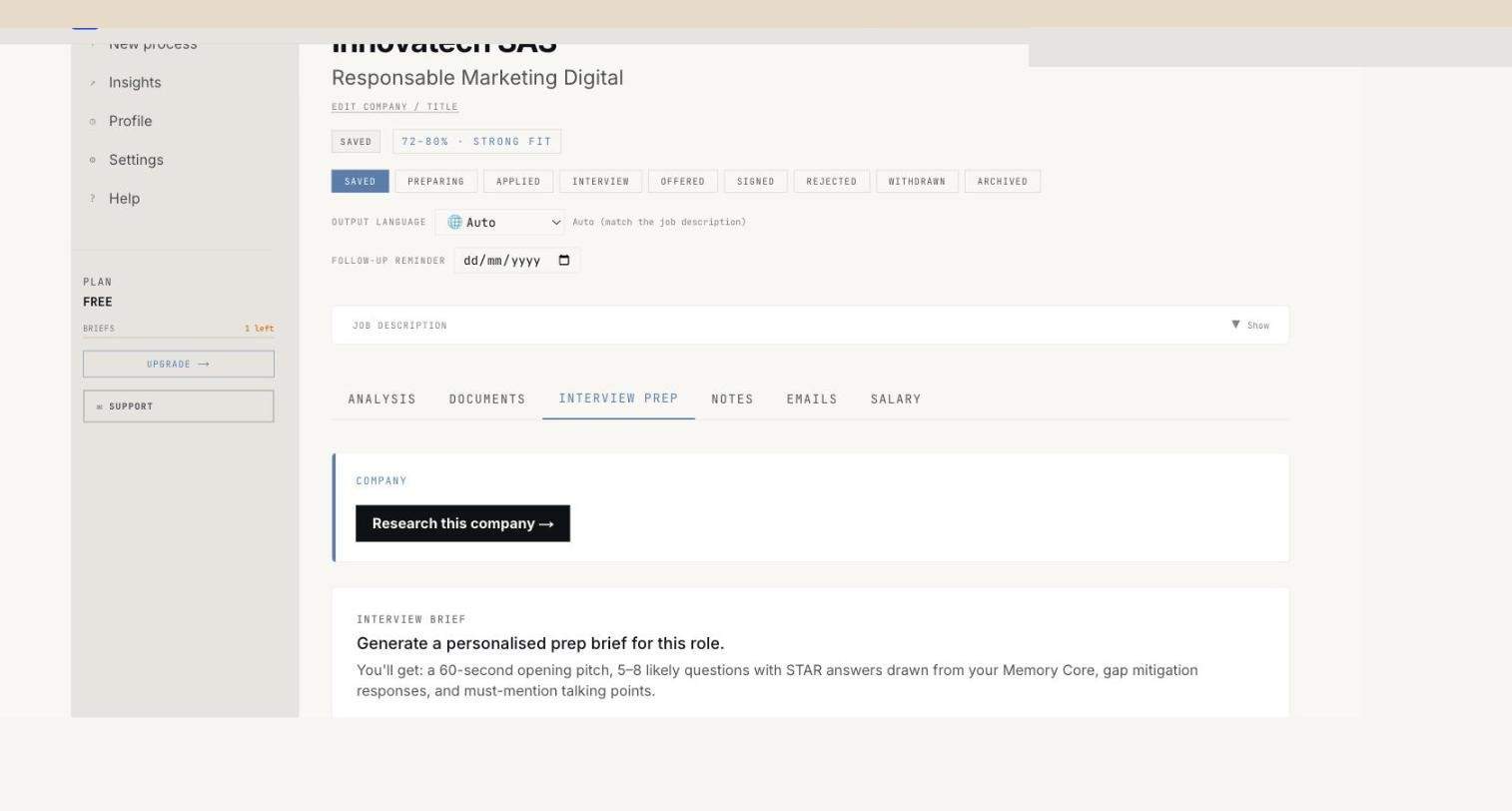
The "Interview Prep" tab helps you prepare for interviews with two distinct tools: company research and the interview brief.

Interview Prep tab
🔍

Research this company

Generates a report on the company: news, values, market positioning, strategic challenges.

🎯

Interview Brief

Creates a personalised preparation guide with likely questions, your strengths to highlight and gaps to anticipate.

Recommended useStart with "Research this company" 48 hours before the interview to get to know the company well. Then generate your "Interview Brief" the day before to structure your answers.
3.4

Notes

A dated log of every exchange

The "Notes" tab is where you record what actually happened: who you spoke to, when, what was asked and what you promised to send. Nothing here is generated. It is your own record, and it is what the AI reads later when it writes a thank-you email or an interview brief.

📅

One entry per exchange

Each note carries a date, a type (phone screen, technical, panel, final, offer call), the interviewer's name and your own text.

⭐

Rating and next steps

Rate how the conversation went from 1 to 5 and write down what happens next, so nothing is left to memory.

Write them the same dayThe interviewer's name and one concrete thing they said are what turn a generic thank-you email into a specific one. Both are gone from memory within a week.
3.5

Emails

Six ready-made messages, and one legal request

The "Emails" tab holds six templates. Each one is already filled in with the company name and the job title, so you copy it and send it. Five of them have an AI button that rewrites the message using your analysis and your interview notes; the sixth does not, and that is deliberate.

📨

Follow-up

After applying with no reply.

🙏

Thank-you

After an interview. Reads your notes for something specific to reference.

💬

Salary opener

Opens the compensation conversation without naming a number.

🚪

Withdrawal

Leaving the process while leaving a good impression.

🤝

Referral request

To someone you know inside the company.

⚖️

Data access request

After a rejection. Covered in detail below.

Open a card with "View"

The full subject line and body appear. Everything is already filled in.

Optionally press "AI"

The message is rewritten from your own analysis and notes. Press it again to regenerate, or "Reset" to go back to the standard version.

Press "Copy" and paste it into your mail client

Job-Agent never sends anything on your behalf. You always read it and send it yourself.

LanguageThe five standard templates are written in English. If your process uses another output language, the card says so and the AI button gives you the message in that language. The data access request is different: it exists in English, French, Spanish, German and Italian, and picks the one matching your process.

The data access request, and why it exists

When an application is turned down after going through a company's careers portal, a decision about you was recorded somewhere you cannot see: a score, a ranking, a recruiter's note. Article 15 of the GDPR gives you the right to ask for a copy of it. This template is that letter.

It is deliberately not generated by the AI. It is a legal request, so it should read the same every time and cite the right articles. A machine-written variation would only make it easier to dismiss.

Send it to the data protection officer, not the recruiterLook for a dpo@ or privacy@ address in the company's privacy policy. Sent to a careers inbox it may never reach anyone who can answer it.

Tracking the reply

The company has one month to respond. Job-Agent tracks that for you, but only once you tell it the letter has gone out.

Set the process to "Rejected"

A "Mark as sent" button appears at the top of the page, on the same line as the status and your fit score. It is deliberately there rather than in this tab: once the letter is out, the deadline matters more than the letter.

Press it on the day you send the letter

The button is replaced by a countdown, and the dashboard card for that process starts showing the reply date too.

Record who you sent it to

Back on this card, a field holds the address you used. You will want it if you have to follow up.

Paste the reply when it arrives

Whatever they send back goes in the box on the card. A real reason for a rejection is the only reliable signal you will ever get about how you were actually assessed.

If the month passes with no answerThe countdown turns red and a note appears explaining the next step: a follow-up that cites Article 77 and names the supervisory authority in the company's country. Your first letter deliberately does not mention them, because that reads as a threat before anyone has had a chance to reply.
3.6

Salary

Prepare the negotiation before the call

The "Salary" tab holds the numbers for this specific role and turns them into a negotiation brief. Enter the range advertised, the offer once you have one, and your own target. Then generate the brief.

💶

The numbers

Advertised range, first offer, your counter and the final figure, each recorded as the conversation moves.

🗣️

The brief

A suggested counter with the reasoning behind it, talking points drawn from your own analysis, your red lines, and an opening sentence.

The brief is a starting point, not adviceIt is built from the job description and your Memory Core, and it knows nothing about the local market, the company's budget or your own circumstances. Read it, keep what fits, and decide for yourself.
4

Your profile - Memory Core

Professional identity extracted from your CV

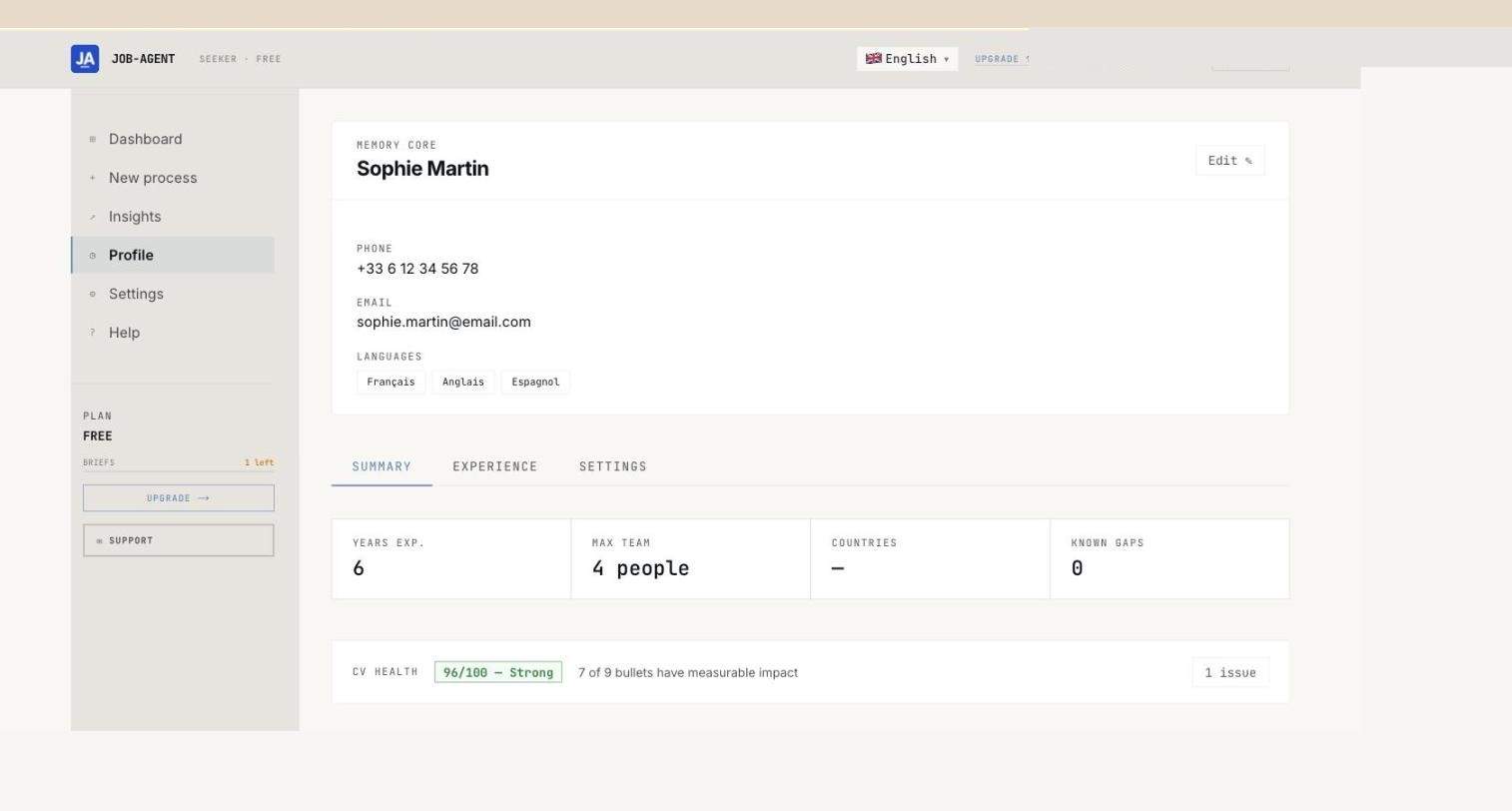
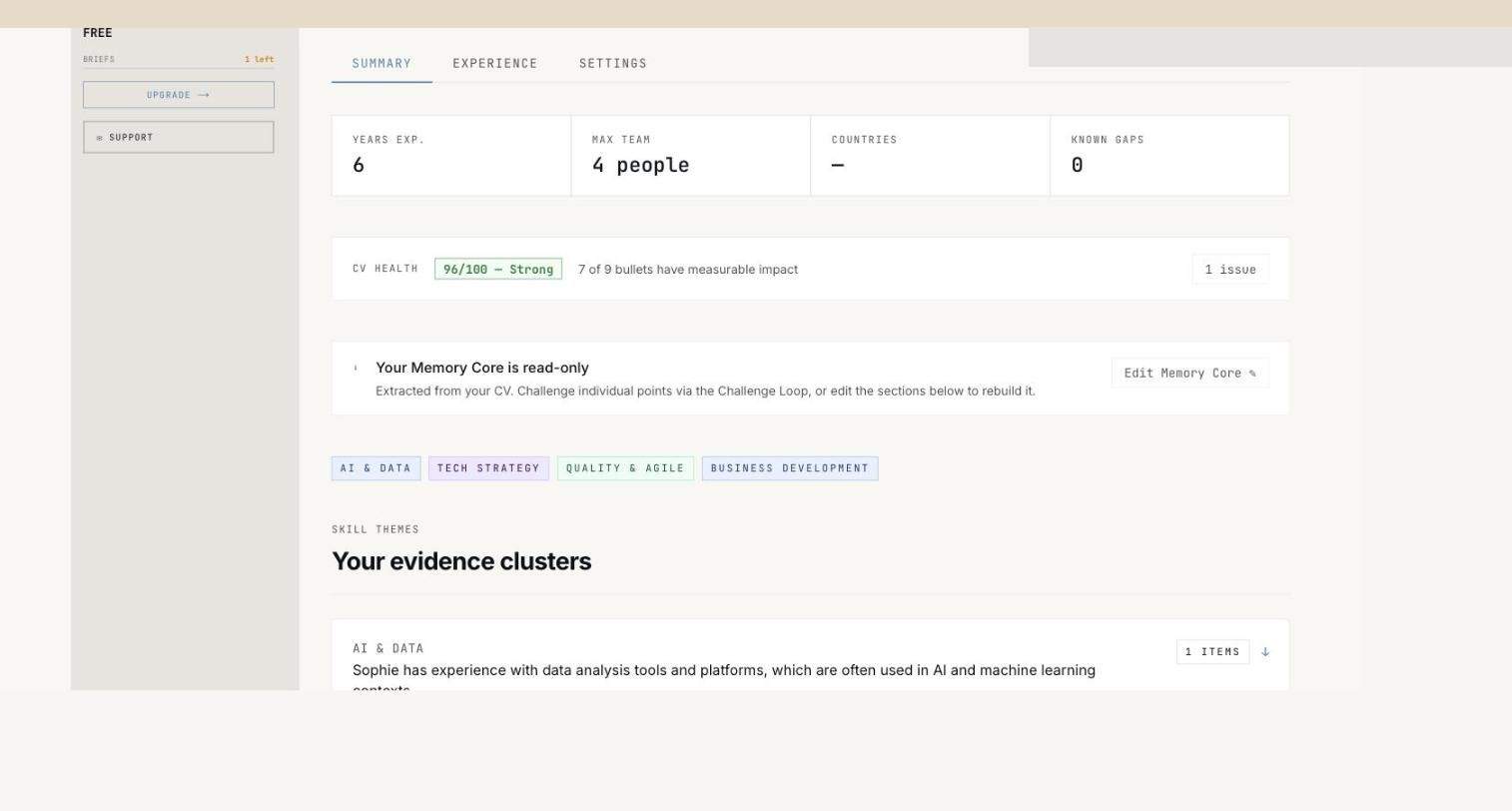
The Profile page is the heart of Job-Agent. It displays your Memory Core: the professional themes, evidence clusters and indicators detected from your CV.

Memory Core profile
👤

Basic information

Name, phone, email, languages spoken. Automatically extracted from your CV.

💯

CV Health Score

Quality score for your CV (96/100 for Sophie Martin). Indicates the completeness and structure of the source document.

Themes and evidence clusters

Themes and evidence clusters

Job-Agent identifies your key professional themes and the "evidence" (experiences, projects, results) that supports them:

AI & DATA TECH STRATEGY QUALITY & AGILE BUSINESS DEVELOPMENT
How is the Memory Core built?During onboarding, you upload your CV. The AI analyses it and automatically extracts your professional themes, roles, experience and key skills. This profile is then used for all fit analyses.
5

Insights

Analytics for your job search

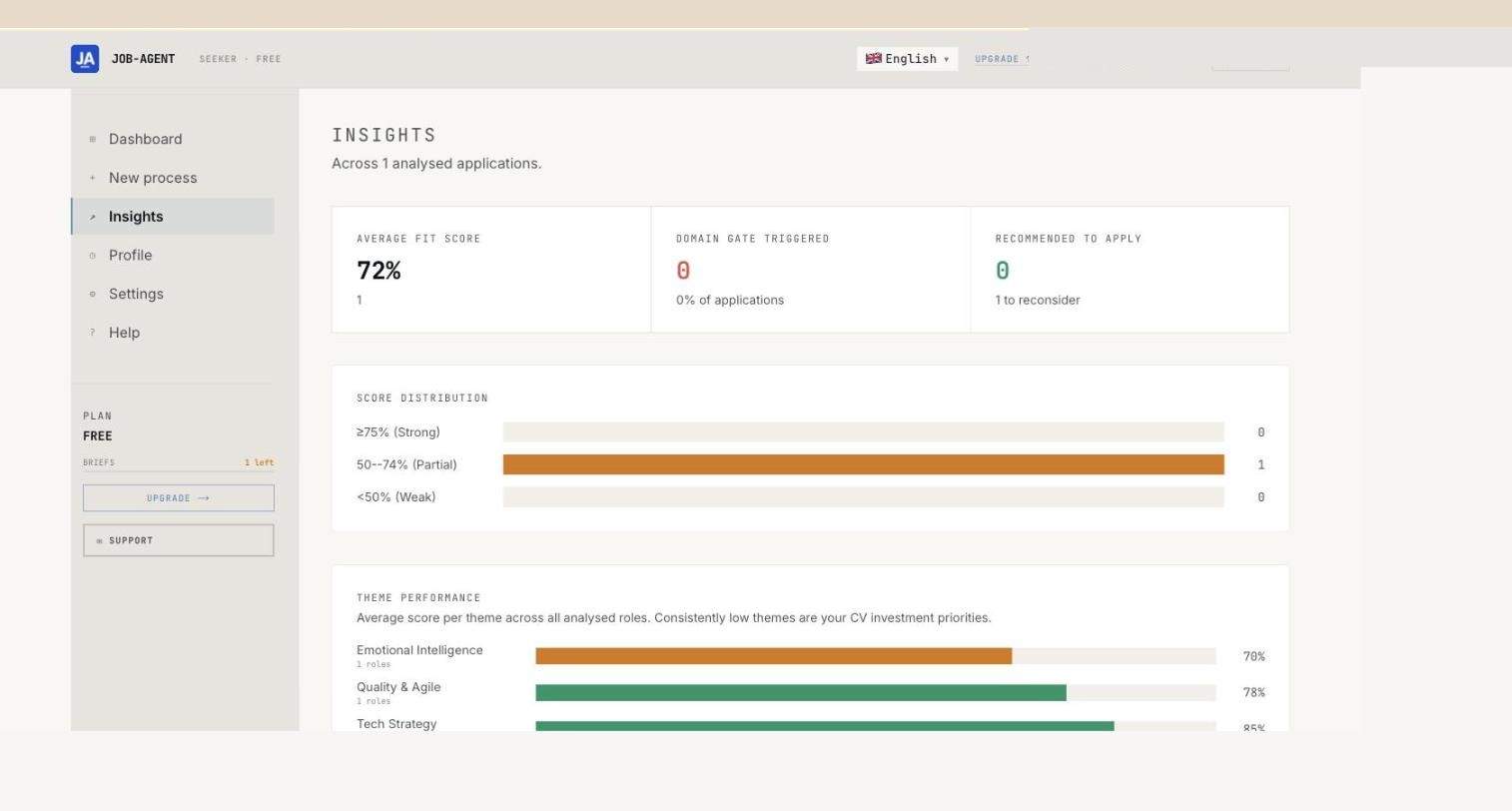
The Insights page provides a comprehensive analytical view of your search: score distribution, performance by theme, trends in your applications.

Insights page
📊

Average score

72% fit score across all of Sophie Martin's active applications.

📉

Score distribution

Distribution chart to visualise whether your applications are well targeted or too spread out.

🎯

Performance by theme

Which themes from your Memory Core perform best across your applications?

Using Insights to improveIf your average score stagnates below 65%, revisit your Memory Core: your source CV may be too generic. Add quantified results and keywords specific to your target sector.
6

Tips to get started

Getting the most out of Job-Agent

Recommended workflow

Polish your source CV

Upload a complete, structured CV with quantified results. The richer your CV, the more accurate your Memory Core and the more relevant your analyses.

Check your Memory Core

After uploading, check the Profile page. Verify that the detected themes accurately reflect your real skills. If a theme is missing, enrich your CV.

Paste the full description

When creating a process, always paste the full job description, not a summary. The AI needs the complete text for an accurate analysis.

Generate documents before applying

Never apply with your generic CV. Always use the tailored CV and cover letter generated for each application.

Prepare your interviews with the brief

As soon as you get an interview, generate an Interview Brief and the Research this company report. This makes a notable difference in your preparation.

Check your Insights regularly

Visit the Insights page each week to identify patterns: which types of roles suit you best, which themes open the most doors for you.

NoteScreenshots in this guide show the English interface, which is the default language of the application.